
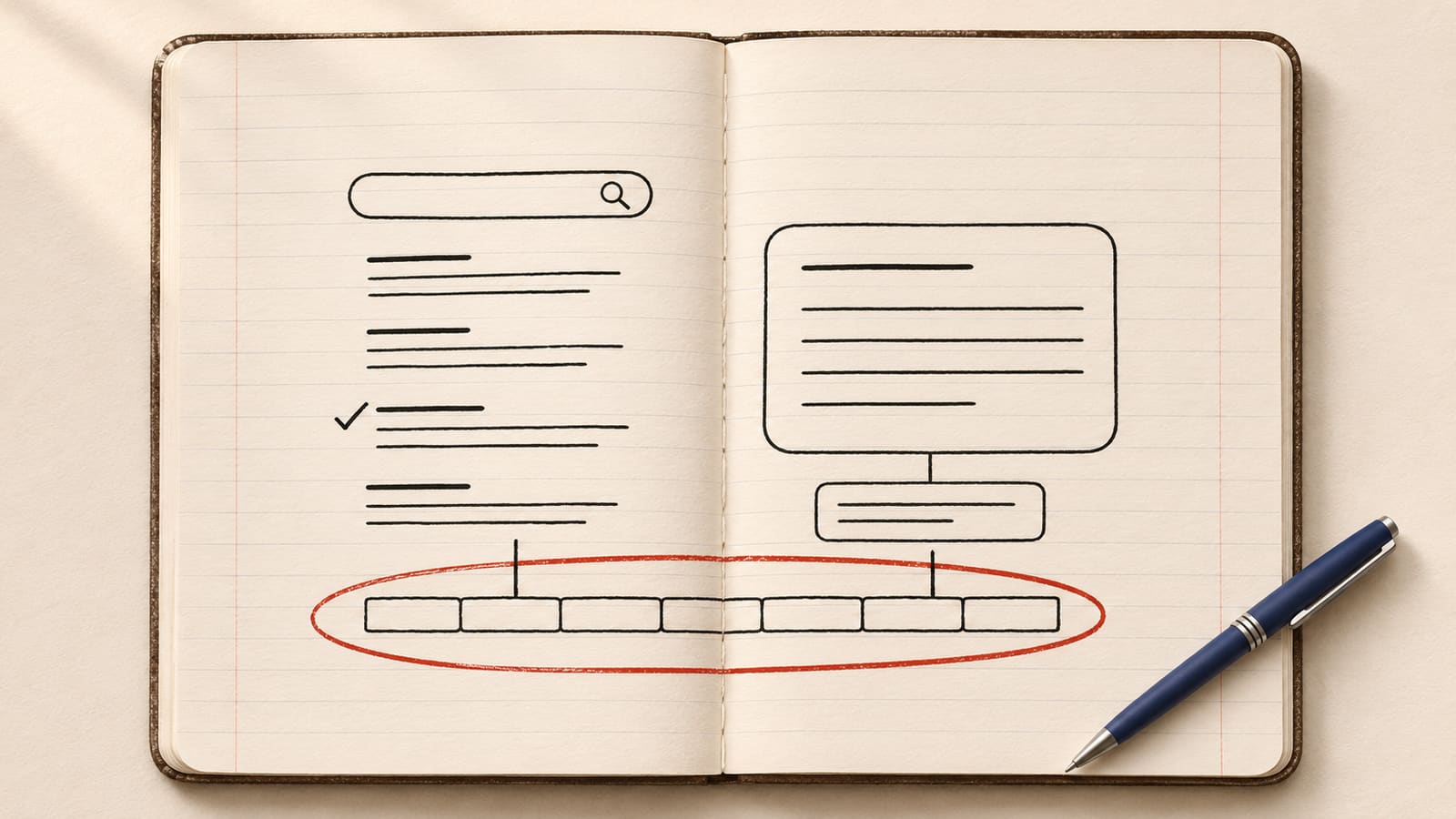
AEO vs SEO comes down to what you want to win. SEO (search engine optimization) works to get your page into Google's list of results, high enough that people click it. AEO (answer engine optimization) works to get your words used in the answer itself. It can be a featured snippet at the top of Google, or a cited source in an AI answer from ChatGPT, Perplexity or Google. For Google, the two are the same work, and Google says so in writing. A few extra checks sit on top, about which other engines can read your site.
What each one tries to win
Google's starter guide says SEO is about helping search engines understand your content, and helping people decide whether to visit your site from a search. The prize is a click from a list of results. If your page sits fifth for "CA for GST registration in Bengaluru", SEO is the work that moves it up.
AEO aims at the answer, and the answer can sit in several places:
- A featured snippet. Google's help page describes it as a box with the answer right at the top, taken from one website. It adds that these boxes help when you use a phone or talk to your device.
- AI Overviews and AI Mode in Google Search, which show links to supporting websites next to an AI-written response. AI Overviews are available in India, in English, Hindi and several other Indian languages.
- ChatGPT search, which can answer with current information and links to relevant sources.
- Perplexity, which adds numbered citations linking to the original sources to each answer.
- Microsoft Copilot, which Microsoft says is powered by Bing's search index.
In each of these, a reader may get what they need without visiting you. Being the quoted source keeps your name in front of them, and the link gives them a way to reach you.
AEO vs SEO side by side
| SEO | AEO | |
|---|---|---|
| What you want | Your page ranked high in a list of results | Your words used in the answer, with your page linked as a source |
| Where it shows | Google and Bing results pages | Featured snippets, AI Overviews and AI Mode, ChatGPT search, Perplexity, Copilot |
| Who has to read your site | Googlebot and Bingbot | The same two, plus OAI-SearchBot for ChatGPT and PerplexityBot for Perplexity |
| What the engines say helps | Useful pages Google can crawl, linked from your other pages | The same, plus plain question-and-answer sections (Microsoft's advice; Google asks for no special format) |
| What you count | Position, impressions and clicks | How often links to you appear in AI answers |
| Where you count it | Search Console's Performance report | Search Console's Generative AI performance report, and Bing Webmaster Tools' AI Performance report |
Where AEO and SEO are the same work
Google answered this in its guide to generative AI search. It names AEO and GEO as terms for work aimed at AI search. Then it says that from its side, optimizing for generative AI search is still SEO. Its AI features use Google's core ranking systems to pull pages from its own search index. They then write a response with links to those pages.
That gives AI features the same entry rule as ordinary results. A page must be indexed and eligible to be shown with a snippet, and Google sets no extra technical requirement. It also says you need no AI text files and no special schema (labelling code, also called structured data) to appear.
Microsoft says much the same for Copilot and Bing. Its Bing team wrote that crawlability, metadata, internal linking and backlinks remain essential, and called them the starting point.
If Google cannot index your site, AEO work will not help you in Google. Start with the reasons a site does not show on Google.
Where they differ in practice
The base is shared, and the differences are smaller. Know them before you pay anyone for "AEO".
- More engines have to reach your site. ChatGPT search reads sites through its own crawler. OpenAI says to allow OAI-SearchBot to crawl the site. Your host, or a service in front of it such as Cloudflare, must also let its traffic through. Perplexity asks the same for PerplexityBot, and says a firewall may need a rule to let it in. A site Google reads well can still be shut out of ChatGPT by bot protection at the host.
- The answer has to be easy to lift. Microsoft's guidance says assistants can often lift question-and-answer pairs word for word, and suggests answers of one or two sentences. It warns against hiding answers in tabs, PDFs or images. Google says there is no need to break content into tiny parts or rewrite it for AI. Either way, a plain answer near the top of the page, followed by the detail, suits both engines and your readers.
- Structured data. Google says there is no special schema for its AI features. Microsoft says schema helps its systems read a page as a product, review, FAQ or event. Keep the structured data you have, and keep it matching what the page says.
- You cannot pick the answer. Google's page on featured snippets asks how to mark a page as one, and answers You can't. OpenAI says ChatGPT search promises no one a place in its results.
What to do for both this month
Say you run a physiotherapy clinic in Pune. These six steps serve your Google ranking and your chance of being quoted, at the same time.
- Check that Google has indexed your main pages. Paste each address into the URL Inspection box in Google Search Console.
- Open
yourwebsite.com/robots.txt. Make sure it does not block Googlebot, Bingbot, OAI-SearchBot or PerplexityBot. Ask your developer or host whether a firewall or bot protection blocks them. - Write down the ten questions patients ask most on calls and WhatsApp. One might be "Do I need a doctor's referral?" Answer each one on the right page, in its first two sentences.
- Put prices, areas served and timings on the page as text. A price list that exists only as an image or a PDF is hard for any engine to quote.
- Update your Google Business Profile. Google's AI features page lists up-to-date Business Profile information among the basics.
- Once a month, open Search Console's Generative AI performance report. It counts how often links to your site appeared in AI Overviews and AI Mode, by page, country and device. Bing Webmaster Tools added an AI Performance report in February 2026, in public preview. It counts citations in Copilot and in Bing's AI summaries.
Results take time. Google's starter guide says some changes show in a few hours and others take several months. It suggests waiting a few weeks before you judge.
What not to pay for
- An llms.txt file for Google, a text file written for AI tools to read. Google's guide says its search ignores LLMS.txt files, so one neither helps nor harms you there.
- A separate page for every way a question can be phrased. Google's guide counts it as scaled content abuse, against its spam policies, if the aim is to manipulate rankings or AI answers in Google Search.
- Bought "mentions" across the web. In Google's words, seeking inauthentic mentions "isn't as helpful as it might seem".
- A promise of AEO rankings. Google's guidance on outside SEO services names AEO and GEO tools. It says third-party tools have no access to its ranking data and cannot promise performance.
Questions owners ask
Are AEO and SEO the same?
For Google's own search, yes. Google says optimizing for its AI features is still SEO, and a page needs nothing beyond normal indexing to appear in them. The extra AEO work is letting other engines such as ChatGPT and Perplexity read your site, and answering questions in plain words.
What is the full form of AEO and SEO?
SEO stands for search engine optimization, the work of helping search engines understand a site and helping people find it. AEO stands for answer engine optimization, the work of getting a site's content used in direct answers, such as featured snippets and AI answers.
What is the difference between AEO, SEO and GEO?
SEO aims for a ranked link in search results. AEO and GEO (generative engine optimization) both aim for a place inside AI-written answers. Google groups AEO and GEO together as terms for work on AI search, and treats both as part of SEO.
What is an example of AEO vs SEO?
Say someone in Jaipur searches "documents for GST registration of a proprietorship". SEO is the work that gets your CA firm's page to the top of the results list. AEO is the work that gets your page's document list into the AI Overview or featured snippet, with a link to you.
Do I need to pay separately for AEO?
In most cases one job covers both, since Google treats AEO as part of SEO. If an agency quotes AEO as an extra package, ask which steps it adds beyond SEO. For what SEO itself costs, see our guide to SEO cost in India.
See where your site stands on both
Our free report checks both sides of your site. It checks whether Google can index your pages, and reads the title and description on your home page and up to 10 more. It checks that AI crawlers are allowed in your robots.txt and not blocked by bot protection, and whether Google AI Overviews name you. It runs three Google searches from your city and shows who Google puts above you. You get an email summary within a working day.
Sources
- developers.google.com/search/docs/fundamentals/seo-starter-guide
- support.google.com/websearch/answer/9351707
- developers.google.com/search/docs/appearance/ai-features
- support.google.com/websearch/answer/14901683
- help.openai.com/en/articles/9237897-searching-the-web-with-chatgpt
- perplexity.ai/help-center/en/articles/10352895-how-does-perplexity-work
- about.ads.microsoft.com/en/blog/post/october-2025/optimizing-your-content-for-inclusion-in-ai-search-answers
- developers.google.com/search/docs/fundamentals/ai-optimization-guide
- docs.perplexity.ai/docs/resources/perplexity-crawlers
- developers.google.com/search/docs/appearance/featured-snippets
- support.google.com/webmasters/answer/16984139
- blogs.bing.com/webmaster/2026/2/Introducing-AI-Performance-in-Bing-Webmaster-Tools-Public-Preview
- developers.google.com/search/docs/fundamentals/third-party-seo